
- Despre Institut
- Echipa
- Laboratoare
- Enciclopedia socială şi studii regionale
- Europa Socială
- Metodologie calitativă aplicată
- Religie şi societate
- Sociologia comunicării și spațiului public
- Sociologia organizaţiilor, intervenţie în întreprinderi şi dialog social
- Sociologie politică
- Sociologie rurală și analiza comparativă a comunităților
- Teorie socială
- Observatorul Român pentru Analiza și Prevenirea Omorurilor
- Sociologia familiei și cuplului conjugal
- Cercetare
- Evenimente, noutăți
- Publicatii
- Anunturi
- Documente
- Contact

Books by the institute's researchers
|
Social Romania. Faces of change. Processes, problems, social situations
Ilie Bădescu, Cristi Pantelimon (eds.) Romanian Academy Publishing House, 2022, 403 p. ISBN 973-27-3443-8 |

|
|
Dictionary of rural sociology
Ilie Bădescu, Ozana Cucu Oancea (eds.) Mica Valahie Publishing House, 2005 ISBN 973-7858-05-0 |
|
|
Treatise on Rural Sociology
Ilie Bădescu, Ozana Cucu-Oancea, Gheorghe Şisestean (eds.) Mica Valahie Publishing House, 2009, 744 p. ISBN 978-973-7858-38-2 |

|
|
On the crisis in light of the theory of coexisting succession
Ilie Bădescu Expert Publishing House, 2009, 124 p. ISBN 978-973-159-060-8 |

|
|
Encyclopedia of Sociology
Ilie BădescuVolume I – The Founders Volume II – Contemporary Sociological Theories Mica Valahie Publishing House, 2005 ISBN 973-7858-17-4 |

|
|
A Civil Society with no Hierarchy : The Covenantal Societal Model
Ilie Bădescu, Joseph Livni (eds.)Lexington Books Publishing House, Lanham, 2023 ISBN 9781666903713, 166690371X |

|
|
Creation and ruin
Ilie BădescuVol 1- Print Book Publishing House, Vol. 2-4 - Mica Valahie Publishing House, Vol 1-3 - 2022, Vol. 4 - 2024 ISBN: Vol. 1 - 606-738-085-9, Vol. 3 - 606-738-087-3, Vol 4.978-606-738-084-2 |

|
|
The Social Dolj. Rural and small urban communities. Demographic decline, aging, migration. The specter of the disappearance of communities in rural and small urban in Dolj county. Analysis and measurement.
Ilie Bădescu, Adela Șerban, Maria Mitrică (eds.) Romanian Academy Publishing House, 2024 ISBN 978-973-27-3912-9 |

|
|
From mediocracy to meritocracy: the knowledge society and the new elites
Ion Glodeanu, Oscar Hoffman Expert Publishing House, 2007, 200 p. ISBN 978-973-618-137-5 |

|
|
Knowledge. The new resource of power
Ion Glodeanu, Oscar Hoffman Intact Publishing House, 2006, 416 p. |

|
|
Methodological issues in the analysis of social realities
Oscar Hoffman, Gheorghe H. Popescu Universitaria Publishing House, 2009, 343 p. ISBN 978-973-749-596-9 |

|
|
Violent crime
Ecaterina Balica Oscar Print Publishing House, 2008, 318 p. ISBN 978-973-668-201-8 |
|
|
Family violence against children – a multidisciplinary perspective
Sorin M. Rădulescu, Cristina Dâmboeanu Ars Docendi Publishing House, 2010 |

|
|
Innocents and erotic violence (Sexual abuse of minors in the family)
Sorin M. Rădulescu Lumina Lex Publishing House, 2010 |
|
|
The sociology of deviance and social problems
Sorin M. Rădulescu Lumina Lex Publishing House, 2010 |

|
|
Societal security. Theoretical foundations
Adela Şerban Valahia Publishing House, 2008, 220 p. ISBN 978-973-88815-6-3 |

|
|
Europe in public space
Camelia Beciu, Nicolae Perpelea (eds.)Romanian Academy Publishing House, 2007 ISBN 9-789732-715000 |

|
|
Europa in European context
Camelia Beciu, Nicolae Perpelea (eds.)Ars Docenti Publishing House, 2011 ISBN 978-973-558-527-3 |

|
|
Homicide. Trends, risk factors and media representations
Ecaterina Balica, Radu Gavriș (eds.), Univeritary Press of Cluj Publishing House, 2023 ISBN 978-606-37-1829-8 |

|
|
Homicide-Suicide in Romania. Statistical data and media representations
Ecaterina BalicaPeter Lang Publishing House, 2016 ISBN 9783631695760 |

|
|
Migration and crime. Realities and Media Representations
Ecaterina Balica, Marinescu Valentina (eds.) Palgrave MacMillan Publishing House, 2018 ISBN 978-3-319-95813-2 |
|
|
Mediation in the criminal field in Romania – evaluation and development perspectives
Andrea Parosanu, Ecaterina Balica, Ana BalanC. H. Beck Publishing House, 2013 ISBN 9786061801923 |

|
|
Children and digital technologies during Covid-19. Online school, internet risks and parental mediation
Anca VelicuTritonic Publishing House, 2023 ISBN 978-606-749676-5 |

|
|
Questionner la diversité culturelle. Organisations, médias et création à l’ère de la mondialisation
Camelia Beciu, Matina Magkou, Franck Renucci, Gheorghe-Ilie Fârte (eds.) University ”Alexandru Ioan Cuza” of Iași Publishing House, 2023 ISBN 978-606-714-808-4 |

|
|
Societal security and insecurity
Adela ȘerbanRomanian Academy Publishing House, 2013 ISBN 978-973-27-2388-3 |

|
|
Romania in the context of the new pandemic crisis. Vulnerabilities, risk factors, threats. A socio-political radiography
Veronica DumitrascuPro Universitaria Publishing House, 2021 ISBN 978-606-26-1350-1 |

|
|
Borders and civilizations. The Eastern border of the European Union: geopolitical and identity aspects
Veronica DumitrascuRao Publishing House, 2014 ISBN 978-606-609-665-2 |

|
|
Experiencing the holidays - between meditation and partying
Ozana Cucu-OanceaEminescu Publishing House, 2001 ISBN 973-22-0858-9 |

|
|
From Moș Gerilă to Santa Claus. A sociological look at Christmas.
Ozana Cucu-OanceaSemne Publishing House, 2006 ISBN 973-624-371-0 |

|
|
The Sea of Writers
Ozana Cucu-OanceaCartea Românească Publishing House, 2012 ISBN 978-973-23-2972-6 |

|
|
Compared Noology of Jewish and Romanian People
Mădălina MăndițăShaker Verlag GmbH Publishing House, Aachen, 2017 ISBN 978-3-8440-5176-6 |

|
|
Romanian sociology of spiritual manifestations
Mădălina MăndițăRomanian Academy Publishing House, 2017 ISBN 978-973-272-776-8 |

|
|
The Romanian family. Social evolution and contemporary challenges
Iulian ApostuTritonic Publishing House, 2016 ISBN 606-749-122-7 |

|
|
The Bucharest Sociological School and the Study of the Family
Iulian Apostu, Maria VoineaArs Docendi Publishing House, 2019 ISBN 978-606-998-087-3 |

|
|
Mediation of family conflicts
Iulian Apostu, Maria VoineaProuniversitaria Publishing House, 2020 ISBN 978-606-26-1297-9 |

|
|
Man and Woman. The Image of a Controversy on Gender Equity
Iulian Apostu, Cristina PetrescuLumen Publishing House, 2017 ISBN 978-973-166-465-1 |

|
|
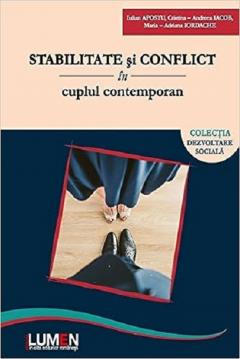
Stability and conflict in the married couple
Iulian Apostu, Cristina-Andreea Iacob, Maria-Adriana Iordache Lumen Publishing House, 2017 ISBN 978-973-166-464-4 |
|
|
The married couple - The challenge of a new identity
Iulian Apostu (eds.)Pim Publishing House, 2019 |

|
The study of Romanian society as a type of European society at the turn of the millennium reveals phenomena, processes, situations and social problems that are defining for what could be included in a picture of social alarm. Some processes, such as the demographic winter, the decline of progeny, the maternity crisis, the rise of optional sterility, transformations of community morphology, the decline of the "middle class economy", the child-victim, the axiological turbulences induced by the transition and aggravated by the pandemic crisis, etc., touch the whole, affect, in other words, the balance of society as a whole.
The dictionary of rural sociology is part of the tradition opened by the Sociological School in Bucharest. A team of authors from all the university centers of the country collaborated to create it: Bucharest, Cluj, Oradea, Iaşi, Braşov, Craiova. The dictionary is structured in four sections (terms, personalities, currents, magazines) and cumulates, on a surface of approximately 650 pages, a number of over 300 terms.
Starting from the Gustian model, the Treatise on Rural Sociology proposes an examination of the picture of the basic social problems of the countryside and also the picture of the doctrines and theories in which solutions to such problems have been formulated. To carry out this project, the team of coordinators within the Institute of Sociology brought together researchers and specialists in the field of rural sociology and studies on community problems.
The theory of coexisting successions, developed in the field of Romanian culture by academician Tudorel Postolache, opens a new phase in the evolution of theories of civilization. In the vision of this new approach, civilizations develop new “hard cores” through which the law of identity triumphs in everything that exists. On the other hand, civilizations obey In their becoming, by the law of coexisting succession, according to which the world became the scene of a civilizational co-evolution on a planetary scale with effects still unexplored.
Volume I presents the period of the great systems, that is, the founders of sociology, the establishers of the discipline. Volume II is dedicated to contemporary sociological series. The two volumes followed the same editorial method: presenting the sociological series through its representative figures. The Encyclopedia of Sociological Theories thus becomes an encyclopedia of paradigms, selecting and presenting everything through exponential personalities, highly relevant for a sociological explanatory model.
Societies without explicit and centralized leadership have been identified by anthropologists in tropical forests or prairies, living in the form of nomadic pastoral communities. “Covenantal” societies are another type of communities without hierarchical leadership, some found in the civilized world and which take a sedentary form. The paper includes a collection of updated research on this type of societal model, from the perspective of relevant aspects in the disciplinary field of sociology, political science or the administration of justice.
The collapse represents a cycle of four volumes dedicated to societal and cultural destructions that take the form of collapse from the foundations. The first volume is dedicated to theoretical contributions to the understanding of this type of phenomenon and was developed using the method and categories of "abysmal noology" and noological sociology. The second volume is dedicated to the spirit of conservation and sustainability of a type of humanity illustrated on a planetary scale by the so-called village civilization, of the small village communities that make up peasant societies. The third volume is dedicated to deepening substructural economies, and the fourth deepens the problem of the socio-demography of substructural destruction.
The book is a synthesis of the results obtained within the project "Analysis and measures to improve the phenomena of demographic decline, aging and migration and reduce the risk of disappearance of rural and small urban communities in Dolj County. Substantiation and proposals for integrated projects", carried out within a partnership with the Dolj County Council in order to consolidate existing action strategies. The book offers an extensive image of the social vulnerabilities of the villages and towns in the county, as well as solutions and strategic measures for action and for substantiating future development projects.
The new knowledge-driven economy is being promoted by the new knowledge class. The “middle class” (specific to industrial society) is transforming into a knowledge-based class, on the skills of creating, processing, disseminating and using knowledge (university professors, researchers, consultants, managers, new workers involved in IT, new union leaders practicing non-conflictual relations, trainers of highly qualified personnel, media personnel, etc.).
Meritocracy (D. Bell) becomes the "pivot" class of the new society, "penetrating" the old structures of the bourgeoisie-workers type.
The research into new types of organizations specific to knowledge-driven societies (cognitive-intensive organizations, knowledge exporting organizations, organizations in knowledge transfer networks) gives new characteristics to labor relations. From conflictual models, models of organizations based on cooperation and partnership emerge. The new labor relations imply a new vision of work and professions. Work and non-work activities They are starting to get closer to new lifestyle models.
The concerns of systematizing the methodological research directions of the field considered by the members of the team within the Institute of Sociology - concerns that were also highlighted in the earlier works - have materialized in the development of a book that includes, among other things, a series of research tools adapted to different types of problems specific to organizations (it is worth mentioning as a novelty the chapters dedicated to research tools appropriate to innovative organizations, in the context of the transition to the knowledge economy).
The book addresses the phenomenon of violent crime in the Romanian space, trying to present a series of aspects regarding the causality, particularities and dynamics of certain types of criminal violence, depending on the social, cultural and political context of the transition period. In the book, the emphasis was placed on presenting the particularities of the evolution and the qualitative and quantitative changes in the produced at the level of crimes of murder, rape, grievous bodily harm and robbery, during the period 1990 - 2006.
The aim is to capitalize on the results of research undertaken within the Project entitled: "Family Abuse of Children and Their Social Protection. Multidisciplinary Victimological Study", carried out through the grant obtained within the "IDEI" Program (Exploratory Research Projects), financed by the National Council for Scientific Research in Higher Education (CNCSIS), during the period 2007-2010).
The book presents some of the findings resulting from the completion of the Project with the theme: "Family Abuse of Children and Their Social Protection. Multidisciplinary Victimological Study", carried out through the grant obtained within the "IDEI" Program (Exploratory Research Projects), funded by the National Council for Scientific Research in Higher Education (CNCSIS), during the period 2007-2010).
This book is addressed, with priority, to specialists in sociology, psychology, law, criminology, medicine or other related disciplines, to professionals who work and contribute in these fields and, ultimately, to students who wish to practice one of them professionally.
The book provides theoretical and methodological clarifications related to the field of societal security - a research topic actively present in the European space in the last three decades - by describing the research horizon, clarifying the basic notions and concepts, presenting the main theoretical challenges identified. The book facilitates the access to the latest theses and theories from the specialized literature, while also capitalizing for societal security studies the theories and the conceptual frames belonging to an entire field of social disciplines.
Is the construction of Europe a beautiful project, but so accelerated that only the academic, journalistic elites or those of the political and administrative bureaucracy could see it?
The analyses presented in this volume attempt to propose to the public, academic, and everyday deliberation, various practices of assuming and interpreting the European system – premises of the cultural construction of a European identity that is made explicit increasingly both from a cognitive point of view and as a "common emotional world".
The analyses presented in this volume attempt to propose to the public, academic, and everyday deliberation, various practices of assuming and interpreting the European system – premises of the cultural construction of a European identity that is made explicit increasingly both from a cognitive point of view and as a "common emotional world".
The emergence of post-communist Eastern European states into the European Union has dramatically changed the nature of European construction. The sense of gravity of this unprecedented extension is found in a multitude of debates that animate the public space: from the “fears” of electoral behavior and the narratives typical of populist journalism, to the promises of the most optimistic political actors. The analyses contained in this volume are rather oriented by the aspirations of a “middle-rank” theory, as K.R. puts it. Merton to designate "analytical generalizations" based on descriptions, cases, and facts from multiple sources.
The book offers professionals interested in the issue of homicide an interdisciplinary approach to the acts of lethal violence committed in Romania. In the first part of the book, the general context was described by relating the concept of homicide to the sphere of lethal violence and reviewing the studies carried out in our country on different types of murder. Then, the results of studies on murder in large urban areas, murder committed by young people, femicide, special orphans, media coverage of murders, etc. were presented.
The book presents the results of the first research conducted in Romania on murder-suicides committed between 2002 and 2013. The author analyzed data from: interviews with prisoners who committed murder or attempted murder-suicides, police records, indictments from prosecutors' offices, criminal files from prisons, and online media articles reporting on murder-suicides. The paper includes information on victims, perpetrators, and risk factors specific to certain types and subtypes of murder-suicides: femicide-suicide, familicide-suicide, filicide-suicide, and murder-suicide committed by police and military personnel.
The book brings together studies that address the issue of international migrants from several areas of the world. Some studies analyze how international and national media have presented international migrant flows, others present aspects of migrant trafficking or acts of violence committed against migrants. The book brings information from: Great Britain, Germany, Turkey, Syria, Iraq, Chile, Slovenia, Albania, Hungary, the Republic of Moldova and Romania.
The book brings to the public space the results of a national survey on the opinion of prosecutors and judges regarding the implementation of mediation in the criminal justice system. The work has the merit of constituting an x-ray of the practices of professionals in the justice system, on which occasion the difficulties of implementing restorative practices in the criminal justice system were highlighted.
The book provides an overview of the situation of children's use of digital technologies during the COVID-19 pandemic, approaching the subject from three complementary perspectives, intended to structure the analytical approach: that of the use of digital technologies in a school context, that of the possible negative impact at the individual level (i.e. exposure to online risks) and that of parental mediation. Although it is a book resulting from research, it is not addressed only to the academic environment or students, but to a wider audience, including teachers, parents and, why not, even young people.
The book offers complementary approaches to the representations and organization of cultural diversity at the level of organizations, media and creative activities, questioning new forms of diversity. It is the result of the 25th Franco-Romanian conference on communication sciences, which took place in Iași in May 2022, at Alexandru Ioan Cuza University.
The book presents a new and innovative approach of community and its security needs. The book holistically addresses different dimensions and levels of social reality and proposes a new model for understanding on societal security, starting from the community morphological design.
What are the real threats to Romanian society and how should they be remedied? What are the problems at the demographic, social, educational, medical, and infrastructure levels? Are these brought to the attention of policymakers? The book attempts to answer these questions using a theoretical framework drawn from the specialized literature, but also concrete data that show Romania's real problems on several levels.
Borders and frontiers seem to be a thing of the past in a Euro-Atlantic Romania. But it is the past that has drawn some painful frontiers on the emotional map of Romanians. A significant part of the Romanian population across the borders is in Ukraine and the Republic of Moldova, states that are not members of the Euro-Atlantic institutions. In the two countries, the criteria of multiculturalism and minority rights are, for now, optional and applied arbitrarily. The aim of this book is to demonstrate that Euro-Atlantic integration does not mean the destruction of the identity, cultural and civilizational core of a country and that, on the contrary, a rational and dispassionate discussion on this topic must be held precisely in order to heal historical idiosyncrasies.
“In a chosen and balanced harmony, metaphysical meditation is combined with religious reflection, historical research and sociological investigation of an essential manifestation of a human community: the celebration, understood as a "vibration of existence" (according to Paul Drogeanu's expression). The researcher captures and reveals the synchronization of the theory and methodology of the Gusti school with the state of Western sociology; at the same time, she combines the investigations of the monographic vision of the Gusti School with the philosophical meditation of the thinker Vasile Bancilă and the sociologists Ion Ionică or Ernest Bemea, and reaches the research and meditations of Paul Drogeanu, Ion Ghinoiu or Cezar Baltag, after also passing through Simeon Florea Marian, Petru Caraman or Romulus Vulcănescu." (Marin Diaconu, Universul Cărții)
Continuing my concerns related to the sociology of the holiday expressed in the author's first book ("Experience the Holidays - Between Meditation and Partying", 2001), "From Santa Claus to Santa Claus. A Sociological Perspective on Christmas" argues that, regardless of the era or circumstances, holidays play a determining role in achieving community balance. Starting from the analysis of two important historical factors that contributed to the spiritual degradation of the community, atheist communism and commercial capitalism, the work emphasizes the idea of the need to rethink life strategies, in the sense of revaluing spiritual manifestations as a factor of geopolitical and cultural balance.
The book brings together a number of testimonies that, situated at the intersection of memoir, psychological notation, political anecdote and socio-literary history, present from a unique perspective impressions and memories collected “live” from and about contemporary Romanian writers and pre- and post-revolutionary socio-literary life, as it unfolded at the “Zaharia Stancu” Writers’ House in Neptun over the past 40 years. The objectives of this editorial project were, on the one hand, to reconstruct the objective and subjective history of the place, reflected in the representations (memories) of its “inhabitants”, and on the other hand, to highlight the role that the “Zaharia Stancu” Writers’ House played in the 40 years of its existence for the community of Romanian writers (in different dimensions – creation, rest, socialization, etc.).
The book focuses on the spiritual powers identified within the religious dimension (Judaism and Romanian Orthodox Christianity) - strong enough to shape identities and form a specific cultural profile. Following the paradigm that reveals the role of the spiritual dimension in sociology, we develop a system of analysis of two peoples, based on four categories of spiritual latencies: the latency of discovering divinity, the latency of trembling in the face of evil, the latency of salvation and the latency of meaning in/of the world.
A sociology of spiritual manifestations, through in-depth research on two levels, community and elite, can provide us with a complex understanding of current social problems. On these foundations, we can identify new types of spiritual manifestations in today's society, such as: faith as magic, faith as duty, faith as habit, faith as non-belief, faith as power.
The contemporary challenges felt throughout the Romanian social system tend to produce structural changes in its basic cell - the family. Thus, if in the traditional space solidarity implied the rigid assimilation of a set of imperatives regarding role attitudes, gender attitudes and functional expression, in modernity young people build their own rules, dreams, ideals and relating to them creates an organic type of solidarity that guarantees their emotional security. The work deepens these themes, offering an innovative perspective.
The book is part of the project of an encyclopedia of the Bucharest Sociological School, as part of a comprehensive encyclopedia of Romanian civilization, as it was conceived within the framework of the NER project. Until this work, we lacked the syntheses through which we could gain access to the knowledge of the family in the dimensions of an inclination of over a quarter of a century, belonging to some of the prominent members of the Bucharest Sociological School. The book highlights the functional structure of the family in the rural environment, the household, the traditions, the social imperatives of the rural community, the forms of solidarity and social assistance.
Often, everyday stress finds its echo in the most intimate space of the individual – his or her own marital environment. At the same time, the contemporary challenges of a society in continuous transition also put additional pressure on partners. Today, the image of man and woman is also undergoing continuous transformation, with direct effects on the type of marital relationship, on the forms of internal cohesion, on the role dynamics and on the management of power in the couple. In this context, the logic of building marital solidarity becomes the key to deciphering the type of marital relationship – solidarity, as a cultural predefinition of a system that sees the couple cohesive through the very decision of choosing a partner or solidarity, as the effect of two individual accomplishments.
In contemporary society, women carve their way to success with great diligence and determination. The unshakable landmarks in the life of a modern woman are social affirmation and financial independence, landmarks that until recently were associated with male status. Today, the modern woman breaks the barriers of prejudice and seeks the light of equality and social equity, after a long and arduous journey in which she fought for her due rights. This fact also has consequences in the area of marital relations, where the modern woman demands equality in the distribution of household tasks, demands more time for her professional career, etc.
The social challenges of contemporary times tend to influence all subsystems and perhaps, first of all, the family one. Thus, from the traditional space to the trends of post-modernity, the family has known a diversity of ways of being. The trends of conjugal individualism increasingly affect the solidarity of the marital couple through a continuous action that increasingly relies on individual needs. In this sense, the book aims to investigate in detail the causes that contributed to the transformation of the conjugal couple in order to form a clearer opinion on the new trends and challenges regarding conjugality.
About two decades ago, marital behaviors that showed relational individualism seemed almost unworthy of a loving relationship between partners. Thus, the separation of budgets, major changes in the authority structure, the role structure and, of course, the gender structure appeared to be atypical and incomprehensible to those who wanted a functional and solidary couple around principles consecrated by the community to guarantee marital success. Equally undesirable were attitudes that carried images of sensuality and sexuality into the public space, which, according to a conjugal culture that defined the social space of the first years after the revolution, had to remain intimate to the partners.
Webmaster: Iuliana Serban